When Should a Creative Freelancer Ask for a Deposit?
A date in your diary is not a booking just because somebody sent you a heart emoji and said “sounds good”.

Day 1: Somebody sent a heart emoji…
Picture this. A couple asks about your last free Saturday in June, you send your price, and they reply with a heart emoji and “sounds good”. Lovely, but that is not a booking: you ask for a deposit once the scope and terms are clear, before you reserve the date.
Short answer: ask for a deposit once the scope and terms are clear and before you reserve the date. There is no universal percentage: base it on your costs, the time you are holding and the work you will turn away. UK consumer law can affect deposits and refunds, so write fair, clear cancellation terms.
Day 2: you pencil them in. But in your heart, it's pen.
Day 5: another couple asks for the same Saturday. You tell them, with great dignity, that it's taken.
Day 19: the heart emoji has not replied.

Here's the thing: a Saturday is not a square on a calendar. It's a wedding, the travel, a long day and the editing after. Hold it for someone who never confirms and you've turned away someone who would have.
And no, a deposit doesn't mean you think every client is a flight risk. It just means you've stopped dating heart emojis.
When should you ask for a deposit?
So when? Once the client has accepted the scope and your written terms, and before you treat the date or project slot as confirmed.
Say what they're paying, when the balance is due and what the payment actually secures. In writing, like an adult.
For a wedding, that might be the moment the agreement is signed. For a design project, before the first round of work.
Not halfway through a friendly chat, like a plot twist nobody ordered.
Confirm the scope, written terms, booking amount, payment deadline, remaining balance and cancellation arrangements. Then send one clear invoice or payment request, not a treasure hunt.
How much deposit should you charge?
Now, the percentage. Everybody wants the magic number.
There isn't one.
Weigh your costs, the time you're holding, the work you'll turn away and the size of the job. A fixed amount, a percentage or staged payments can all work. For example: on a £1,500 booking, a 30% deposit is £450, and the remaining £1,050 is due on the date your terms say.
Then there's the law. In the UK, consumer law and the actual circumstances can affect deposits and refunds, so typing “NON REFUNDABLE” in capitals does not automatically settle it.

If a consumer books your service at a distance (online, by email or by phone), the law usually gives them 14 days to cancel without giving a reason (Consumer Contracts Regulations 2013, regulation 30). Keep it fair. Get advice when you need it.
Ignore anyone online selling a dramatic “industry standard” percentage. The internet also thinks pineapple on pizza is a criminal offence.
I'm a photographer. I am not your legal department.
Then the bank details go out. Four times…
Put the total fee, the booking amount, the due date, the balance and the payment methods on a proper invoice or payment request, then confirm when it's paid.
Your client should know the exact moment “we discussed the date” becomes “the date is secured”. So should you.
Because the alternative goes like this. Message one: bank details. Message two: sorry, wrong sort code. Message three: “what reference?” Message four: an apology about the reference.
That's not a payment process. That's a group chat.

And then, somebody wants to cancel…
Nobody enjoys talking about cancellations while the booking is still warm. But later is worse.
In plain English, say what happens if the client moves the date, cancels or needs less work, when money may come back, and how finished work is handled.
Working with consumers? Then your terms need to be fair and legally appropriate. The answer depends on the agreement, the jurisdiction, the timing and the actual loss.
Good terms are like a spare memory card. You pray you never need it. You're very glad it's in the bag.
Day 23: The deposit finally lands…
Then, one fine morning, the deposit lands.

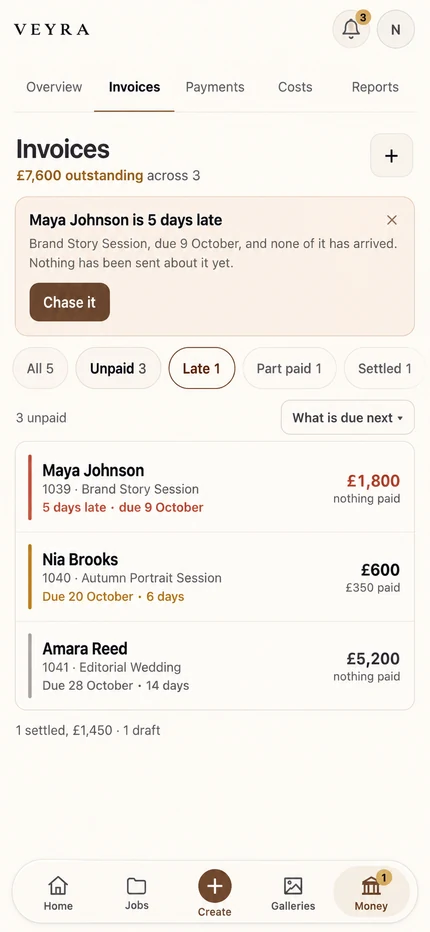
Now it needs to sit against the right client, invoice and project, so you know what's paid, what's outstanding and what's confirmed.
A screenshot of a bank transfer buried between your sunset shots is not an accounts system. Veyra's invoices and payment links exist to make that simpler. I build it, so I would say that.
And the heart emoji? Lovely. Send the invoice anyway.
Discussion
Thoughts, questions or something you would add?