How Creative Freelancers Can Get Paid on Time (Without Awkward Chasing)
You finished the job beautifully. Now you’re drafting a payment reminder as though you’re asking to borrow the client’s car. We need to talk.
You have sent the invoice. Why do you feel guilty?
There are few sentences more astonishing than “Sorry to bother you about the payment.”
You did the work. You delivered the work. The client agreed to the price. Yet here you are, apologising for the outrageous act of wanting to be paid for your own labour.
Creative people can spend three hours choosing the right crop and thirty minutes trying to word “your invoice is overdue” so delicately that it eventually becomes a weather report.
Getting paid on time does not require you to become a debt collector with a ring light. It does require a little structure, an obvious way to pay and the courage to write a normal sentence.
A very unglamorous founder memory.
I remember working through Veyra’s payment alerts and noticing that a notification could tell me a payment had happened without immediately giving me the whole useful picture: which invoice, how much had arrived and what remained outstanding.
We had to improve that. Because if a notification makes you open three other screens to understand the good news, congratulations: the notification has assigned you homework.
That tiny detail sums up how I think about money tools. They should answer the questions a busy creator actually has, without a second detective shift. Is the deposit in? What is still due? Which job is it for? When is the next payment?
Your payment terms should speak before the awkwardness does.
Before a shoot, design job or film project begins, get the basics into writing: what you are delivering, what it costs, whether there is a booking payment, when the rest is due and what happens if the scope changes.
You do not need a 48-page document written as though the client is purchasing a small island. You need clarity that both sides can refer back to.
For a bigger job, a staged payment plan can make more sense than one heroic invoice at the end. The exact arrangement is yours to agree, but the important part is that neither of you discovers the schedule halfway through editing.
And if you charge a deposit, call it what it is in your terms and explain whether it is refundable. An unclear policy is how a normal business conversation becomes a group chat with screenshots.
Make paying you easier than finding your Instagram.
Your invoice should show the client’s details, what they are paying for, the total, the amount already paid, the balance, the due date and a clear payment method. Ideally they can act on it straight away.
The last thing you want is a client replying, “Hi, where are the bank details again?” — followed by you scrolling through a thread that started during a completely different government.
Give clients sensible ways to pay, keep receipts, and make the next instalment obvious. A beautiful invoice is nice. A beautiful invoice that gets paid is an actual achievement.
The reminder message: calm, clear, not apologetic.
First, check that the invoice has actually gone out, the due date is correct and you have not already received the money. Nothing spoils a working relationship quite like chasing a payment that landed yesterday.
“Hi, hope you’re well. A quick note that invoice [number] for [amount] was due on [date] and still appears outstanding on my side. Here’s the payment link again. If you’ve already paid, please disregard this and let me know so I can check. Thanks so much.”
Notice what is missing: seventeen apologies, a life story and the phrase “I’m so sorry to be a nuisance”. You are not a nuisance. You are a business with a due date.
Of course, clients can have genuine problems. Being firm and being kind are not opposites. Listen, document any new agreement and follow it through.
The invoice should belong to the job.
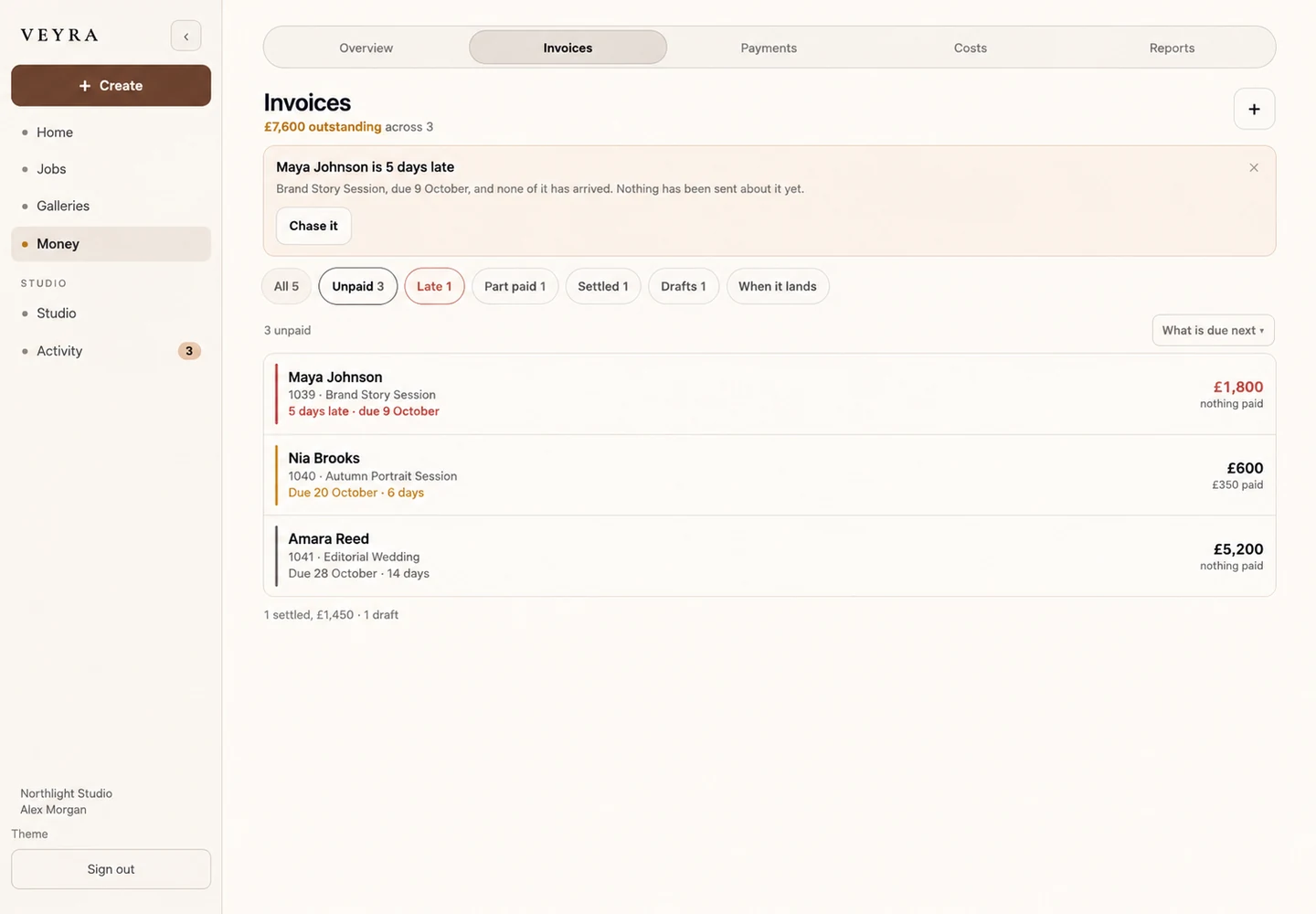
When money sits in one app, the project in another and the client conversation somewhere else, every simple question becomes an expedition. How much did that project earn? Was the final balance cleared? Can I send the files yet under our agreement?
In Veyra, we are bringing invoices, payment links, contacts and projects into one connected workflow. I want the business side to feel as considered as the portfolio side. You can explore the Veyra features on the main site and see how they fit together.
This is not about spending all day staring at revenue graphs. Ideally, you know where the money stands and then get back to doing the thing people hired you for.
Your creative freedom has bills, too.
Start with one small improvement: send the invoice when the milestone is reached, not next week when you “have a quiet moment”. Set a clear due date. Record what was paid. Follow up promptly and respectfully if it was not.
Getting organised about money does not make your work less artistic. It makes it easier to keep making it. Inspiration is wonderful; unfortunately, your electricity provider still seems to prefer pounds.
Discussion
Thoughts, questions or something you would add?